
Reimbursement Arrangements and Federal Subsidies
If you get help paying for coverage through a Reimbursement Arrangement or federal subsidy, you can change your choice during Open Enrollment. The new election will take effect January 1 of the following year.
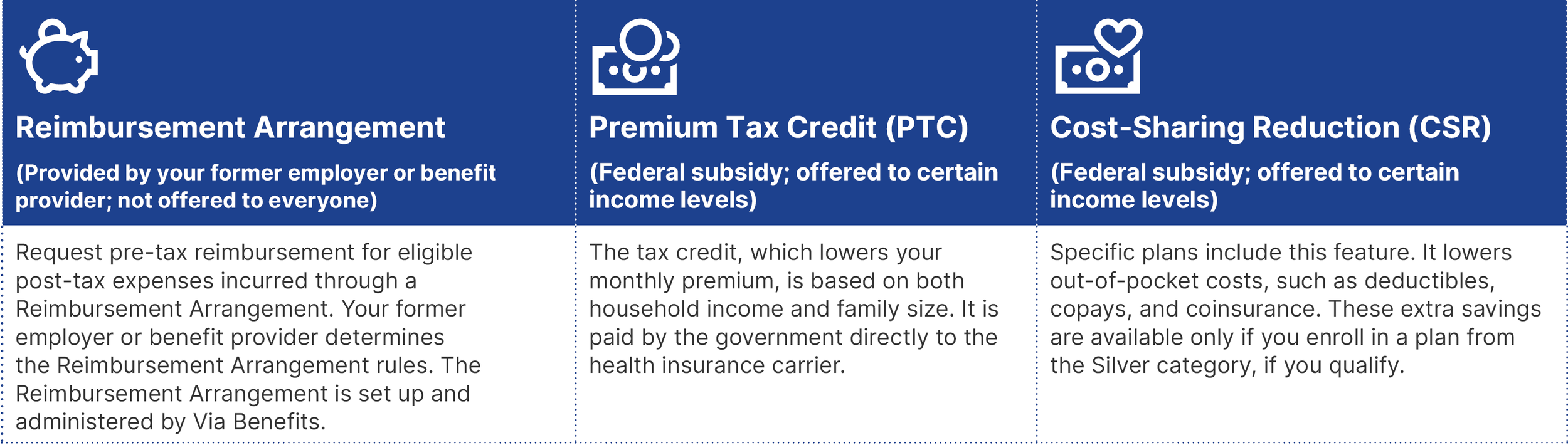
You aren't required to make any changes. If you are happy with the Reimbursement Arrangement (funds provided by your former employer or benefits provider to pay for eligible out-of-pocket healthcare expenses)or the federal subsidy (either a Cost-Sharing Reduction or Premium Tax Credit) you've opted into and haven't experienced any changes to your income level, tax dependents, or ZIP code in the past year, no action is necessary. Unless you've received a notice stating otherwise, your current funding decision will roll over to the next year without any action required from you.
However, if your income level, tax dependents, or ZIP code has changed in the past year, you may want to consider changing your funding decision.
A licensed benefit advisor can assist with these decisions and guide you during your enrollment call.
Funding Types
Qualifying for a federal subsidy (CSR or PTC)
Your household income helps determine whether you qualify for financial assistance, such as a Cost-Sharing Reduction (CSR) or Premium Tax Credit (PTC).
Cost-Sharing Reduction (CSR) Eligibility for 2027
You may qualify for Cost-Sharing Reductions, depending on your household income. To learn more, visit Healthcare.gov.
Premium Tax Credit (PTC) Eligibility for 2027
Eligibility is based on several factors and there is no single income limit that applies. Read Premium Tax Credit to learn more.
Contact a licensed benefit advisor for more information on whether you qualify for a CSR or PTC.